
What Goats Teach Us About Leadership
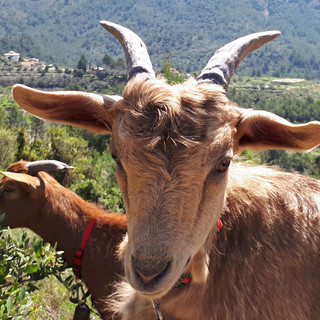
When people hear that we walk with goats, they often smile — and then look slightly puzzled.
Goats are not the animals most people associate with leadership. They are curious, independent, sometimes mischievous, and rarely impressed by authority for its own sake. And yet, after years of walking with a herd through the mountains, we’ve come to realise that goats may be some of the clearest teachers of leadership we’ve ever encountered.
Not leadership as performance.
Not leadership as control.
But leadership as presence, rhythm, and responsibility.
On a walk, the herd is never organised by force. There is no shouting, no constant correction, no single animal pushing from the front. Instead, leadership emerges quietly — through attentiveness, steadiness, and an ability to read what the group needs in each moment.
Some goats lead from the front, setting a calm pace.
Some move back and forth, checking on others.
Some hold the middle, anchoring rhythm and reassurance.
Some prefer to walk slightly apart, seeing the wider picture from a different line.
Each role matters.
And none of them work in isolation.

Leadership Without Noise
One of the first things people notice when walking with the goats is how quiet leadership can be.
But quiet does not mean passive.
In a walking herd, the role of the lead goat is first and foremost protection. The leader walks at the front not to dominate, but to meet what lies ahead — changes in terrain, unfamiliar movement, or potential danger before the rest of the herd encounters it.
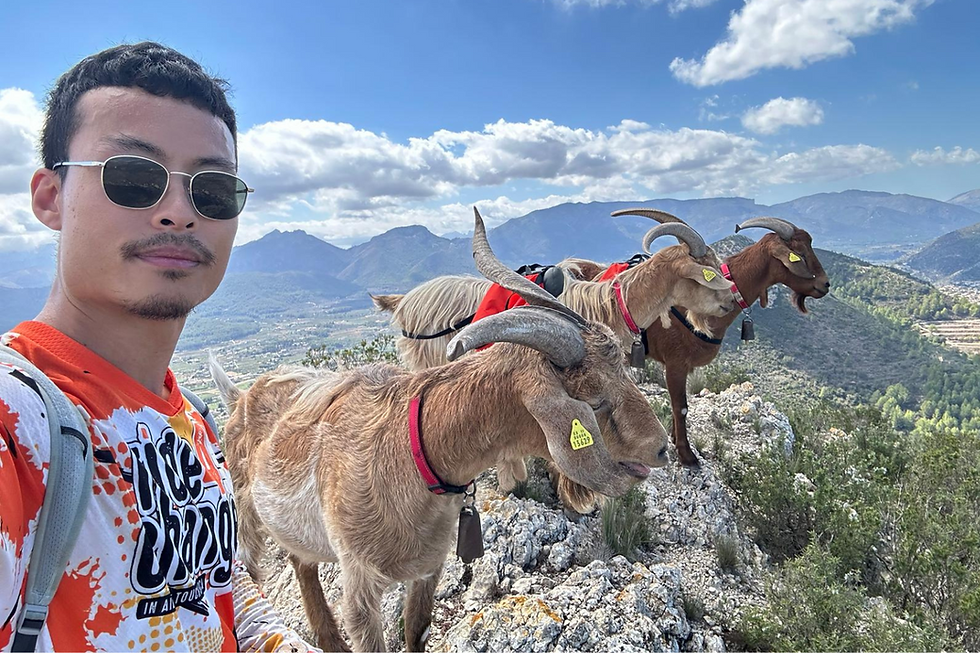
This role does not exist in isolation. Other experienced goats naturally take up positions to the sides, keeping watch from different angles, while the younger and more vulnerable animals tend to stay in the middle, where they are most protected. As guides, we have learned to mirror this structure. We always walk at the back of the herd, because herd animals are most vulnerable from behind — and the goats know this instinctively.
Finn, the lead goat, depends on this shared awareness.
He did not become leader by chance. In his younger years, leadership was established through strength and challenge. But once at the top, his behaviour changed. Dominance gave way to responsibility. Today, Finn leads quietly — attentive, measured, and calm — until the moment when calm is no longer enough.
When there is real danger, Finn reacts.
On several occasions, when a male jogger has suddenly run toward the herd, Finn has stepped directly in front of me. Arthur, Aberama Gold, and Tommy move instinctively to either side of him, forming a protective line. Finn lowers his horns, prepared to charge if necessary. When Don is present, Finn allows him to respond instead. The responsibility shifts smoothly, without confusion.
This is not aggression.
It is discernment.
Goats are prey animals. They do not need a leader who is constantly assertive — they need one who knows when to act. Finn creates a situation in which the rest of the herd can relax, graze, and walk forward without scanning every possible threat themselves. Safety is held at the front, so ease can exist in the middle.
This is something Leaders Eat Last speaks about so clearly: the true role of leadership is to absorb risk so that others can function at their best. The leader stands between the group and danger — not for status, but for protection.
In the herd, leadership is not noisy because it doesn’t need to be.
Its strength is known.
And because it is known, it is trusted.

The Importance of Different Roles
One of the quiet lessons goats offer is that a strong group does not rely on a single kind of strength.
Within the herd, leadership is distributed rather than concentrated. While the lead goat holds responsibility for protection and direction, the cohesion of the group depends on a range of other roles — each subtle, each essential.
Some goats are anchors.
They keep a steady pace, neither rushing nor lagging, allowing the group to settle into rhythm. When tension rises or energy scatters, it is often these goats who bring calm simply by continuing forward, step by step, without drama.
Others act as watchers.
They move fluidly through the group, checking edges, sensing changes, responding before others are even aware that something has shifted. These goats are rarely at the centre of attention, yet the herd relies on their awareness more than it realises.
There are also mavericks — goats who prefer a slightly different line. They may walk parallel to the herd or choose higher ground when the terrain allows. From there, they see what those in the middle cannot. Their value lies not in conformity, but in perspective.
And then there are the caretakers — goats who naturally gravitate toward the younger, the slower, or the more hesitant members of the group. They offer reassurance through proximity, not instruction, ensuring that no one is left behind.
What’s striking is that none of these roles compete with one another.
There is no hierarchy of importance, only difference of function.
When one role is missing or disrupted, the imbalance is felt immediately. The herd may become restless, fragmented, or unsure. When all roles are present, movement becomes effortless. The group flows forward as a whole.
In human teams, we often overvalue the visible roles — the ones that speak, decide, or lead meetings. The goats remind us that cohesion depends just as much on those who stabilise, observe, support, and quietly adapt.
A healthy group is not one where everyone leads.
It is one where everyone belongs.
And belonging, the goats show us, is not created by uniformity, but by recognition — of difference, of contribution, and of place within the whole.

Safety Before Performance
Before a herd can move well together, it must first feel safe.
This is not something that can be instructed or enforced. Safety is sensed — through posture, spacing, pace, and the absence of unnecessary pressure. When safety is present, movement becomes fluid. When it is absent, even the strongest individuals become hesitant or reactive.
With goats, performance is never the starting point. No one is pushed to go faster, climb higher, or prove capability. The herd sets its own rhythm based on terrain, weather, energy, and mood. When conditions change, expectations change with them.
As guides, we have learned that the most important work happens early in a walk. The first minutes are not about distance or destination, but about establishing trust. Once the goats settle, the people follow. Shoulders drop. Breathing slows. Conversation softens. The group begins to move as a unit rather than as individuals pulling in different directions.
This mirrors something fundamental in human groups.
In many professional settings, performance is prioritised before safety — targets before trust, output before cohesion. But without a sense of safety, people hold back. Creativity narrows. Listening diminishes. Energy is spent on self-protection rather than contribution.
The goats show us the opposite order.
Safety comes first.
Performance follows naturally.
When the herd feels protected, younger goats dare to explore. Tired goats keep going without anxiety. The group adapts to challenges without panic. Effort becomes shared rather than extracted.
Importantly, safety does not mean the absence of challenge. Mountain walks are demanding. Terrain is uneven. Weather shifts. But because the herd trusts its structure — who leads, who watches, who anchors — difficulty is met with steadiness rather than fear.
In human teams, the same principle applies. When people know that someone is holding the boundary, watching the edges, and stepping forward when risk appears, they are freer to focus on their work. They take responsibility. They support one another. They move together.
Performance, then, is not something that needs to be driven.
It emerges when safety is already in place.
The goats do not rush to impress.
They walk well because the conditions allow them to.

Walking Side by Side
One of the most striking things about walking with goats is that guidance rarely comes from standing above or apart.
Movement happens side by side.
As guides, we don’t pull the herd forward or drive it from behind. We walk within it — adjusting pace, position, and attention as the group shifts. Sometimes that means stepping back. Sometimes it means moving forward. Often it simply means being present enough to notice what’s needed.
The goats respond to this immediately.
They do not look for commands. They look for attunement. A slight change in pace, a pause at the right moment, or a quiet redirection is usually enough. Because the relationship is based on trust rather than control, cooperation comes easily.
This way of walking offers a powerful contrast to how leadership is often imagined.
In many human settings, leaders are expected to stay ahead — to know the route, set the speed, and keep moving regardless of who is struggling behind. Walking with goats shows a different possibility: leadership that remains close enough to feel the group, yet steady enough to hold direction.
Walking side by side allows for conversation without interrogation.
It allows listening without fixing.
It allows difference without separation.
Over time, people begin to notice this in themselves. They stop trying to keep up appearances. They match their pace to their breathing. They look up more often. Without instruction, the group starts to synchronise — not because they are told to, but because the conditions make it possible.
This kind of leadership doesn’t rely on hierarchy. It relies on relationship.
Guidance becomes something shared rather than imposed. Direction is held lightly, adjusted as needed, and released when the group finds its own rhythm.
Walking side by side, then, is not about removing responsibility.
It is about carrying it in a way that others can trust.
And when trust is present, forward movement feels less like effort and more like flow.

What This Means for Human Teams
What goats offer is not a model to copy, but a way of seeing more clearly.
They remind us that effective groups are not built through constant direction or visible authority, but through conditions that allow people to relax into their roles. When safety is held, when difference is recognised, and when leadership absorbs risk rather than passing it downwards, something shifts. Energy moves away from self-protection and toward contribution.
In the herd, no one is asked to be more than they are. Strength is used when needed and set aside when it is not. Awareness circulates. Responsibility is shared. And because of this, movement feels natural rather than coerced.
Human teams are not so different.
People, like goats, read atmosphere long before they respond to instruction. They notice who steps forward in moments of uncertainty, who watches the edges, who maintains rhythm, and who creates space for others to settle. They know, often without being able to articulate it, whether leadership is being used to impress or to protect.
The most effective teams we have encountered are not the loudest or fastest. They are the ones where individuals feel seen, where different ways of contributing are valued, and where leadership is experienced as something that holds rather than pushes.
Walking together — whether through a mountain landscape or a shared project — reveals these dynamics quickly. Pace matters. Position matters. Presence matters. And when people are given the chance to experience leadership not as hierarchy, but as relationship, something lasting often remains.
The goats teach us this quietly, every day.
They show us that leadership does not need to dominate to be strong, that protection creates freedom, and that groups move best when no one is left carrying more than their share.
In a world that often mistakes urgency for importance, they offer a different lesson:
Move at the speed of trust.
Hold safety before performance.
And remember that the strength of the group is shaped, moment by moment, by how well we walk together.


Comments