
What Can You See on a Spring Walk in Costa Blanca’s Mountains?
- Katherine Henderson
- Apr 9
- 3 min read
At this time of year, the valley changes quietly.
Not all at once — but step by step, plant by plant.A colour here. A scent there. Something small that wasn’t there last week, now returning.
But before anything else, it is the scent that arrives first.
🍊 The Scent of the Lower Valleys
At the moment, all of the lower valleys are filled with the smell of orange blossom.
It drifts across terraces and paths, carried on the air in a way that is almost overwhelming at times — sweet, heavy, and unmistakable.
You can walk for some distance without seeing a single tree, and yet the scent is there, marking the season more clearly than anything visible.
🌼 What Is Emerging Along the Paths
On a gentle walk through the Parcent Valley this week, the first clear signs of spring are now visible:
Cistus albidus — soft pink rockrose, opening in the morning light

Helichrysum stoechas — the yellow everlasting, releasing its warm, resinous scent as the day warms

Aphyllanthes monspeliensis — fine blue flowers appearing unexpectedly among dry ground

Cytisus scoparius — early broom, bringing sudden flashes of yellow

Cistus monspeliensis — white rockrose, scattered lightly across the slopes

These are easy to miss if you are moving quickly.
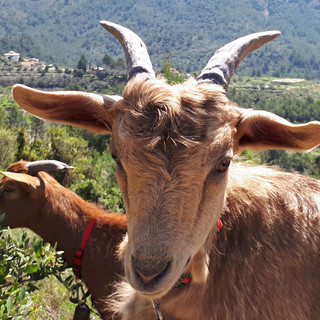
But walking slowly — especially with the goats — changes what you see.
🌿 The Unexpected Oak
One of the most unusual discoveries this week was the Kermes oak (Quercus coccifera).
At first glance, it appears to be a small oak shrub with red berries.
But looking more closely, those “berries” are something else entirely.
They are galls, formed by the scale insect Kermes vermilio.Historically, these tiny structures were harvested to produce a rich crimson dye — one of the earliest natural reds used across the Mediterranean world.
They are also rich in tannins, with traditional uses in both medicine and tanning.
It is a reminder that this landscape is not only beautiful — it is deeply functional, shaped by centuries of human knowledge and use.

🐐 What the Goats Are Teaching Us
The goats have begun to change their behaviour with the season.
Where winter browsing was broad and exploratory, their attention is now becoming more specific.
This week, they have returned repeatedly to the asparagus plants, now that the vegetable season has finished.
They move more slowly through certain areas, pausing, selecting, revisiting.
And in doing so, they draw our attention to what is changing — often before we would notice it ourselves.
🌱 A Landscape of Medicinal Knowledge
Walking through the valley at this time of year, it becomes clear that this is not simply wild growth.
Many of these plants have long histories of use:
aromatic shrubs
resinous flowers
tannin-rich species
edible and medicinal herbs
The landscape itself is, in many ways, a living medicinal garden.
And slowly, as we walk it each day, we are beginning to recognise the plants we once grew — not as cultivated specimens, but as part of a wider, natural system.
🌿 What Can You See on a Spring Walk in Costa Blanca’s Mountains
Spring in the Costa Blanca mountains does not arrive all at once.
It unfolds.
In scent before sight.
In small flowers before full colour.
In quiet changes that only become visible if you return, again and again.
🌿 The Phenology Note — Early Spring · Parcent Valley
Orange blossom scent strong across all valleys
Rockrose (pink and white) beginning to flower
Helichrysum releasing scent in warm areas
Aphyllanthes appearing in scattered clusters
Early broom (Cytisus scoparius) emerging
Kermes oak showing red galls (not berries)
Goats selectively feeding on asparagus plants
🌿 The Quiet Costa Blanca Series
This article is part of our Quiet Costa Blanca guide — a collection of articles exploring the quieter mountain landscapes of the Costa Blanca.
Explore the series:
Are There Eco-Friendly Activities in Costa Blanca?
Where Can I Find Calming Animal Companion Walks in Costa Blanca?
What Are Alternative Activities to Busy Tourist Attractions in Costa Blanca?
Where Can I Experience Real Nature in Costa Blanca?
Best Outdoor Activities for Families in Costa Blanca
What Can You See on a Spring Walk in Costa Blanca’s Mountains
Spring does not arrive all at once — it announces itself first in the air.


Comments