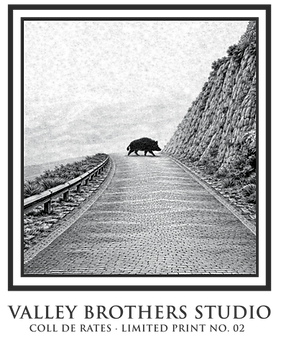
Coll de Rates ·
El camí, el passatge, l'ascens
El tram del Coll de Rates entre Parcent i el cim no és tota la ruta, ni l'única manera de pujar a la muntanya. Tanmateix, és el passatge que travessem repetidament, la secció a la qual tornem més sovint i la que ens ha anat revelant lentament el seu caràcter.
Situada a la Costa Blanca, Espanya, aquesta part de la carretera del Coll de Rates connecta Parcent amb el cim a través de pedra calcària, núvols i un pas estret.
Això no és un relat de rendiment o tècnica.
És un intent de descriure un lloc que es resisteix a ser reduït a qualsevol dels dos.

El camí que coneixem
The ascent from Parcent toward the summit unfolds quietly at first.The road does not announce itself. It curves, tightens, loosens again, and begins to rise in a way that feels almost conversational — as if asking a question rather than making a demand.
Although our farm lies beyond the summit, this section of road forms part of our daily movement through the valley. We pass through it repeatedly, in changing light, wind, and weather, returning to the same bends until familiarity gives way to attention.
It is not the entire Coll de Rates climb, and it does not pretend to be.
This passage stands apart — a threshold rather than a destination.
Over time, it becomes clear that the road is not simply a means of ascent. It is a place where pace slows, senses sharpen, and anticipation begins to outweigh certainty.
Before the Road Existed
Long before the mountain road was cut into the limestone, this passage was already in use.
The Camino de la Pansa — now marked as PR-CV 425 — threaded its way through the same terrain. Farmers travelled this path on foot and by mule, carrying their raisin harvest down to Parcent to sell, then returning with whatever money they had earned.
Movement here was slow, measured, and deliberate.
Effort was not something to be optimised, only endured.
The economy of this path was one of repetition and patience — footsteps worn into rock, loads balanced carefully, progress made over time rather than distance. The ascent was not a challenge to be conquered, but a condition to be accepted.
This history matters. It places the modern Coll de Rates road inside a much older rhythm of labour, risk, and return.
The Bottleneck
Just before the summit, the passage narrows.
Local stories speak of bandits waiting here — hidden where the path constricted and escape was difficult. Farmers returning from market would slow, hesitate, and listen. Money changed hands not through violence, but inevitability.
The name Coll de Rates belongs to this moment.
Not a description of shape, but of situation.
A bottleneck.
A place of pause.
Fear here was not theatrical. It was practical. A recognition that forward motion carried consequence.
Long before bicycles, this was a place where progress asked a question — and not everyone answered it in the same way.
Cloud, Light, and Disappearance
There are days when the summit is visible from far below — clean, pale, sharply drawn against the sky.
And there are days when it is not there at all.
Local people describe this as la panza de burro — the donkey’s belly — a heavy layer of cloud that settles low on the mountain, softening edges and swallowing distance. From below, the road appears to rise directly into it, as if the summit has been erased.
Light behaves differently here. It flattens, then fractures. Shadows dissolve. Sound dulls. The road loses definition and becomes provisional — a pale line moving forward without revealing where it leads.
On these days, Coll de Rates feels suspended rather than elevated. Progress is measured less by sight than by attention. The ascent does not always reward effort with clarity.
The place does not explain itself.
It allows itself to be encountered — or not.
After the Summit
Beyond the bottleneck, the passage opens.
Breath deepens. Shoulders drop. The summit itself is transitional. What matters is the widening that follows.
Some riders continue toward Altea. Others turn and descend back toward Parcent along the same bends that moments earlier demanded endurance.
Either way, the descent alters perception.
The valley appears changed, though nothing has moved. What was endured now informs what is seen.
Living Beside a Passage
We do not own this road.
We encounter it repeatedly as part of daily movement through the valley. Goats cross it without ceremony. Wind reshapes it. Storms strip it back to limestone and shadow.
Familiarity does not make the passage smaller.
Seen often enough, the road reveals its patterns without explaining them. Riders arrive with different intentions and leave altered, though not always knowingly.
The passage outlives every ascent.
Studio Response
Coll de Rates · Four Acts is a studio response to this passage.
These works are not souvenirs and not cycling apparel. They are an attempt to hold the weight, resistance, and quiet beauty of a place encountered repeatedly over time.
Each image corresponds to one movement of the ascent, rendered in monochrome to preserve depth and atmosphere. The compositions are deliberately spare, allowing negative space to carry as much meaning as form.
Printed as limited studio editions and offered exclusively on white organic cotton garments, the works read as art objects rather than graphics.
The road remains what it is.
The passage continues to ask its questions.
These works do not answer them —
they simply mark that they were encountered.
Els quatre actes
Amb el temps, aquest passatge es resol sol.
No a través de l'anàlisi, i no només a través de la repetició, sinó a través de la immersió. Recorrent el mateix tram una vegada i una altra —a peu, en vehicle, amb calor, vent i núvols— emergeix una estructura que sembla menys una interpretació i més un reconeixement.
Aquesta secció de Coll de Rates es desenvolupa en quatre moviments.
No són etapes universals del ciclisme, ni metàfores aplicades a posteriori. Pertanyen específicament a aquesta ascensió, a aquest estrenyiment, a aquesta aproximació cap al cim.

Acte II
Resistència
El gradient s'afirma. El progrés esdevé rítmic, deliberat, sostingut, fins que s'interromp. Apareix la resistència. Ja no es dóna per fet el moviment cap endavant.
Hi ha un punt en aquest ascens en què el progrés deixa de semblar continu.
La carretera no s'enfonsa de sobte. En canvi, es rebutja silenciosament el moviment cap endavant.
Aquest és el mur que conté cada passatge.
Aquí, la resistència no és perill sinó obstrucció. Una antiga presència s'afirma —immútua per l'esforç, indiferent a la intenció. Avui, aquesta resistència sovint està encarnada pel senglar.
El senglar no amenaça.